
How to Verify Clothing Quality Online: A 2026 Guide
Table of Contents
- Start With the Seller: Website Safety and Return Policies
- How to Spot High Quality Fabric Online
- Checking Stitching, Seams, and Garment Construction
- Labels, Tags, and Care Information That Signal Quality
- How to Identify Luxury Clothing Authenticity
- Your Clothing Quality Checklist for Every Purchase
- Sizing, Fit, and Using Customer Reviews Critically
- Conclusion: Shop With Confidence
- Frequently Asked Questions
Last Updated: October 14, 2026
Start With the Seller: Website Safety and Return Policies
Learning how to verify clothing quality online starts before you look at a single garment. It starts with the seller.
A safe retailer shows a real business address, a working phone number, and a return policy written in plain language. If any of those are missing, walk away.
Here is what to confirm before you buy:
- A real contact email or phone number
The Federal Trade Commission's online shopping guidance explains your right to accurate product descriptions and fair return terms.
How to Spot High Quality Fabric Online
Fabric is where most online purchases succeed or fail. You cannot touch the cloth through a screen, so you read the listing instead. The goal is not to become a textile engineer.
Start with the fabric composition. It tells you more than any marketing photo ever will.
Reading Fabric Composition Labels for Durability
A fiber percentage list is a durability forecast. Read it in this order:
- The dominant fiber (listed first) sets the hand-feel. Cotton, linen, and wool tend to breathe and last. Polyester, nylon, and acrylic add stretch, shape retention, and wrinkle resistance.
- The secondary fibers tell you what the blend is for. A small percentage of spandex (often 2-5%) adds stretch. A small percentage of nylon adds abrasion resistance. A small percentage of rayon or viscose adds drape and softness but can pill.
- The total tells you the trade-off. A 100% cotton tee will soften with washing but may shrink. A 60/40 cotton-poly blend will hold its shape longer but feel less breathable.
Blends are not a problem. They are often the smart choice. Our Vida Reversible Sweater blends 62% polyester with 38% cotton, which gives it warmth without heaviness and helps it hold its shape.

Look for these signals in a listing:
- A full percentage breakdown, not just "cotton blend"
- Fiber names you recognize
- A stated weight or feel, such as "midweight" or "lightweight"
If a listing hides the composition, assume the worst.
What Close-Up Photos Reveal About Texture and Weight
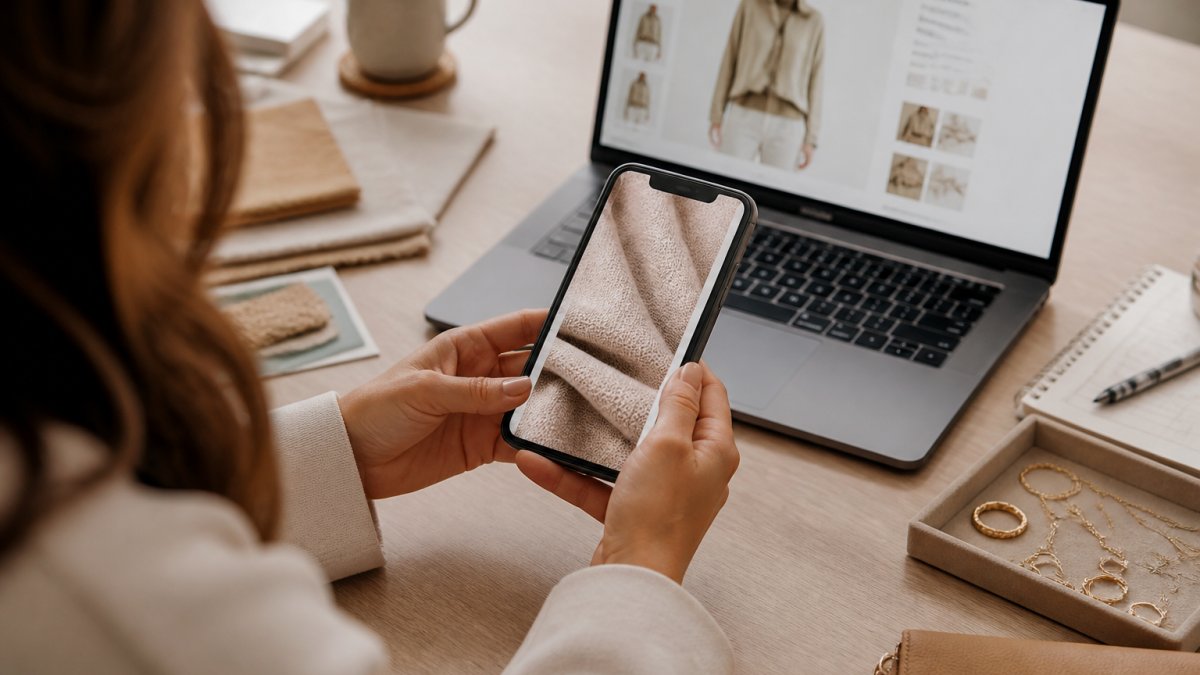
Close-up photos show weave density, texture, and drape. A seller who skips them is hiding something.
Zoom in on the images. You want to see individual threads, not a blurry wash of color. Real close-ups show whether a fabric looks crisp, soft, or thin. Here is what to look for by weave type:
- Plain weave (broadcloth, poplin): tight, flat, and crisp. Good for shirts that need to hold a press.
- Twill (denim, chino): diagonal lines visible on the surface. Denser and more abrasion-resistant than plain weave.
- Knit (jersey, rib): loops rather than straight threads. Stretches in at least one direction. Look for a tight, even loop structure rather than a loose, open one.
- Fleece and brushed fabrics: a fuzzy surface. Check that the pile is even and not patchy, which signals low-quality brushing.
Fabric weight is usually expressed in grams per square meter (GSM) or ounces per square yard (oz/yd²). A common pattern is:
- Lightweight: roughly 120-160 GSM (about 3.5-4.7 oz/yd²), summer tees, linings
- Midweight: roughly 160-220 GSM (about 4.7-6.5 oz/yd²), year-round tees, light sweatshirts
- Heavyweight: roughly 220-400 GSM (about 6.5-11.8 oz/yd²), hoodies, heavy flannels, denim
If a listing states a weight, compare it to those ranges.
Care instructions are part of the quality picture. A garment that requires dry cleaning only is a higher-maintenance purchase.
The American Society for Testing and Materials sets the standards labs use to test fabric strength and pilling.
Checking Stitching, Seams, and Garment Construction
Stitching is the clearest quality signal in any photo. Good construction shows even, tight lines with no loose threads.
Zoom in on the seams. Look at the hem, the shoulders, and the side seams. Even spacing means the maker cared.
Check for these construction details:
- Reinforced seams at stress points like shoulders and pockets
- Clean, straight hems with no puckering
- Matching thread color
- No visible glue or raw edges
A common mistake is trusting the front photo only. Ask for or find images of the inside seams. That is where cheap construction hides.
Labels, Tags, and Care Information That Signal Quality
A real care label tells you the fiber content, the country of origin, and washing instructions. Counterfeits often get these details wrong.
Look for a care label sewn into the side seam, not printed on the outside. The text should be sharp and complete. Blurry fonts, misspellings, or missing fiber content point to a fake.
Quality brands also include a hangtag with the style name and a size tag inside the collar. When those match the listing, you are dealing with a seller who pays attention.
Nova Cropped High Rise Wide Leg →
How to Identify Luxury Clothing Authenticity
Luxury authentication goes deeper than a nice photo. It checks the details a counterfeiter cannot easily copy.
Start with the brand's own authentication guide. Most designer houses publish one. Then compare the item against it point by point.
The U.S. Customs and Border Protection guidance on counterfeit goods explains how counterfeits enter the market and why buying them carries real risk.
Logos, Serial Codes, and Holographic Tags
Logos are the first thing fakes get wrong. Check the font, spacing, and stitching of the logo itself.
Serial codes and holographic tags are harder to fake. A genuine serial number should match across the tag, the receipt, and the brand's records.
If a seller cannot show a clear photo of the serial code, do not buy. Third-party authentication services can also review submitted photos for a fee.
Your Clothing Quality Checklist for Every Purchase
Use this clothing quality checklist before you check out. It takes two minutes and saves you the hassle of a return.
| Check | What to Look For | Red Flag |
|---|---|---|
| Seller | Real address, phone, return policy | No contact info |
| Fabric | Full fiber percentages | "Cotton blend" only |
| Photos | Close-ups of weave and seams | Stock images only |
| Stitching | Even lines, clean hems | Loose threads, skipped stitches |
| Labels | Sharp care tag, size tag | Blurry or missing text |
| Reviews | Buyer photos, fit notes | All 5-star, no photos |
| Returns | Refund to original payment | Store credit only |
Print it, save it, or keep it on your phone. This is the fastest way to judge clothing quality before you spend.
Sizing, Fit, and Using Customer Reviews Critically
Sizing is the number one reason online orders go back. Solve it with measurements, not guesswork. A garment can be well made and still be a poor purchase if it does not fit, so treat sizing as part of quality verification, not a separate step.
Measure a Garment You Already Own
Find the seller's size chart and compare it to a garment you already own and love. Lay that piece flat and measure these points with a soft tape measure:
- Chest or bust: measure across the front, one inch below the armhole, then double the number.
- Waist: measure across the narrowest point, then double it.
- Hip: measure across the widest point, then double it.
- Length: measure from the high point of the shoulder to the hem.
Write those numbers down. Then compare them to the seller's chart. If the chart lists body measurements rather than garment measurements, add ease. A common pattern is 2-4 inches of ease for a relaxed fit and 0-2 inches for a slim fit.
Our Nova Cropped High Rise Wide Leg and Utility Pocket Straight Denim both list their rise and fit clearly, so you can measure before you commit.

Read Reviews Like a Researcher
Star ratings alone are not evidence. A product with 4.8 stars and 200 reviews can still have a fit problem that most buyers did not mention. Read reviews in this order:
- Filter for your height and size. Search the review text for your height range and the size you plan to order. A review from someone five inches taller or shorter is less useful.
- Look for buyer photos. Photos show the real fit on a real body, including how the fabric drapes and where it pulls.
- Note comments about stretch and shrinkage. "Runs small" and "shrunk after one wash" are different problems. The first is a sizing issue; the second is a care issue.
- Ignore reviews with no detail. "Love it" and "Great quality" tell you nothing. Skip them.
- Look for patterns, not outliers. One review mentioning a loose thread is noise. Ten reviews mentioning the same seam problem is a signal.
Check the Return Terms Before You Commit
Even with perfect measurements, some items will not work. Before you check out, confirm:
- The return window
- Who pays return shipping
- Whether there is a restocking fee
If the return terms are vague or the seller charges a restocking fee on every return, factor that into the total cost.
Use a Simple Fit Scorecard
Before you buy, score the listing on four points:
| Check | What to Look For | Red Flag |
|---|---|---|
| Size chart | Garment measurements, not just body measurements | No chart, or chart with no units |
| Reviews | Buyer photos, height and size notes | All 5-star, no photos |
| Return terms | Clear window | Store credit only, restocking fee |
| Fit description | Rise, inseam, and fit type stated | "One size fits most" |
Three or four checks in your favor is a green light. Two is a maybe. One or zero is a pass.
Conclusion: Shop With Confidence
Verifying clothing quality online comes down to reading the details most shoppers skip. Check the seller, the fabric, the stitching, the labels, and the reviews.
That same care is how we build our own collection. Every piece at Shop is hand-picked, ships fast and carefully, and comes with styling support whether you shop online or in store.
Ready to shop with confidence? Browse the Shop collection and find pieces made to fit your life.
Frequently Asked Questions
Can I use a scanner or app to verify if clothes are real?
Some luxury brands use holographic tags or serial codes that can be verified through brand-specific apps or websites. However, most everyday clothing does not have this technology. For non-luxury items, focus on fabric composition, stitching quality, and seller reputation instead. If you are buying designer clothing online, check whether the brand offers an official authentication tool or third-party service. Always compare the item's details to the brand's official product photos and descriptions before trusting any app result.
What are the best indicators of high-quality fabric when shopping online?
Look for detailed fabric composition labels, close-up photos showing texture, and descriptions that mention weight or feel. Natural fibers like cotton, linen, and silk often signal better breathability and durability, though quality blends can perform well too. Check for terms like 'heavy soft wash' or 'midweight' that suggest a substantial fabric. Avoid listings with vague descriptions like 'premium material' and no composition breakdown. Customer reviews mentioning how the fabric held up after washing are also strong indicators of real-world quality.
What should I look for in product photos to judge garment construction?
Zoom in on photos showing seams, hems, and closures. Quality construction means even stitching with no loose threads, matched patterns at seams, and clean finishing inside the garment. Look for photos of the item on a model or mannequin to see how it drapes and fits. If the listing only shows flat-lay images or stock photos, that is a red flag. Clear, well-lit close-ups of fabric texture and details like buttons or zippers help you assess whether the piece is well-made before you buy.
How do I interpret fabric composition labels to judge durability?
Fabric composition tells you what the garment is made of, which affects how it wears over time. Natural fibers like cotton and linen breathe well but may wrinkle; polyester adds durability and shape retention. Blends like 62% polyester and 38% cotton offer warmth without heaviness. Check the care label too, hand wash cold suggests a more delicate fabric. Higher percentages of natural fibers often mean better comfort, while synthetic blends can improve longevity. Match the composition to how you plan to wear and care for the piece.
Leave a comment