
How to Build a Classic Capsule Wardrobe: 2026 Guide
Table of Contents
- Start With a Wardrobe Audit: Shop Your Closet First
- Define Your Personal Style So the Capsule Wardrobe Fits Your Life
- Choose a Capsule Wardrobe Color Palette Built on Neutral Colors
- The Classic Capsule Wardrobe Checklist: Wardrobe Basics by Category
- How Many Pieces in a Capsule Wardrobe? Item Counts That Work
- Capsule Wardrobe Outfit Ideas: Mix and Match Formulas
- Budgeting, Cost per Wear, and Seasonal Wardrobe Adjustments
- Frequently Asked Questions
Last Updated: October 16, 2026
Start With a Wardrobe Audit: Shop Your Closet First
Building a classic capsule wardrobe begins with an honest inventory of what you already own, not a shopping trip. A capsule wardrobe is a small, curated collection of versatile clothing that mixes and matches into many outfits.
The goal is to see what you actually wear versus what simply occupies space. Many women find that a small fraction of their closet gets regular rotation. That gap is where your capsule begins.
The Wear-Frequency Test: A Measurable Way to Audit Usefulness
The wear-frequency test scores each item on how often you reach for it. A common approach is a simple three-tier system:
- Weekly wearers: items you wore in the last two weeks
- Occasional pieces: worn a few times this season
- Dead weight: untouched for a year or more
Items in the first tier are your capsule foundation. The third tier is where decluttering starts. For a deeper look at wardrobe planning and mindful consumption, the EPA guidance on reducing textile waste explains why keeping fewer, better items matters.
Define Your Personal Style So the Capsule Wardrobe Fits Your Life
Personal style is not a mood board. It is a ratio: the share of your waking hours spent in each setting, translated into the pieces that setting requires. A capsule fails when it is built for the life you wish you had rather than the one on your calendar.
Start with a two-week activity log. For each day, note the setting (office, remote work, school pickup, client meeting, gym, dinner out, travel) and the dress code it implies.
Turn Your Calendar Into a Dress-Code Ratio
Map each setting to a formality tier, then assign a rough percentage:
- Casual (jeans, tees, sneakers): weekends, errands, remote days
- Smart casual (trousers or dark denim, button-up, loafers or clean sneakers): most offices, dinners, school events
- Business (blazer, tailored trousers, closed-toe shoes): client meetings, presentations
If 70 percent of your week is smart casual, roughly 70 percent of your capsule should work for smart casual. A capsule weighted toward business pieces will feel wrong every Saturday, and one weighted toward casual will leave you scrambling before every meeting. Write the ratio down before you shop.
The Three-Question Style Filter
Run every candidate piece through three questions:
- Which setting from my log does this serve, and how often does that setting occur?
- Does this combine with at least three pieces I already own?
- Does it fit the body I have now, not a size I am planning to reach?
A piece that fails any question is a costume, not a wardrobe staple. This filter is also where fit and comfort enter the decision. If a blazer restricts your shoulders or a waistband digs when you sit, you will avoid it no matter how classic it looks. Prioritize the fits you actually reach for: relaxed vs. tailored, high-rise vs. mid-rise, cropped vs. full-length.
Once your ratio and filter are set, the rest of the capsule becomes a math problem: fill the dominant setting first, then the secondary settings, then the occasional ones.
Choose a Capsule Wardrobe Color Palette Built on Neutral Colors
A capsule wardrobe color palette usually starts with two or three neutral colors, then adds one or two accents.
Pick neutrals that flatter your coloring and match what you already wear. If your closet is full of black and denim, forcing a cream-and-camel palette will feel foreign.
| Palette Role | Example Colors | Purpose |
|---|---|---|
| Base neutrals | Black, navy, cream, gray | Anchor every outfit |
| Secondary neutral | Camel, olive, brown | Add warmth and depth |
| Accent | Burgundy, sage, blush | Introduce personality |
| Denim | Indigo, light wash | Everyday versatility |
Many stylists recommend keeping accents to roughly a fifth of your wardrobe so the palette stays cohesive.
The Classic Capsule Wardrobe Checklist: Wardrobe Basics by Category
A classic capsule wardrobe checklist organizes essentials by category so you can see gaps at a glance. The categories below cover everyday wear, workwear, and layering pieces that do the heavy lifting.
- Tops: white shirt, basic tees, tank tops, casual tops
- Bottoms: classic denim, jeans, trousers
- Layering: cardigan, quilted jacket, hoodie, blazer
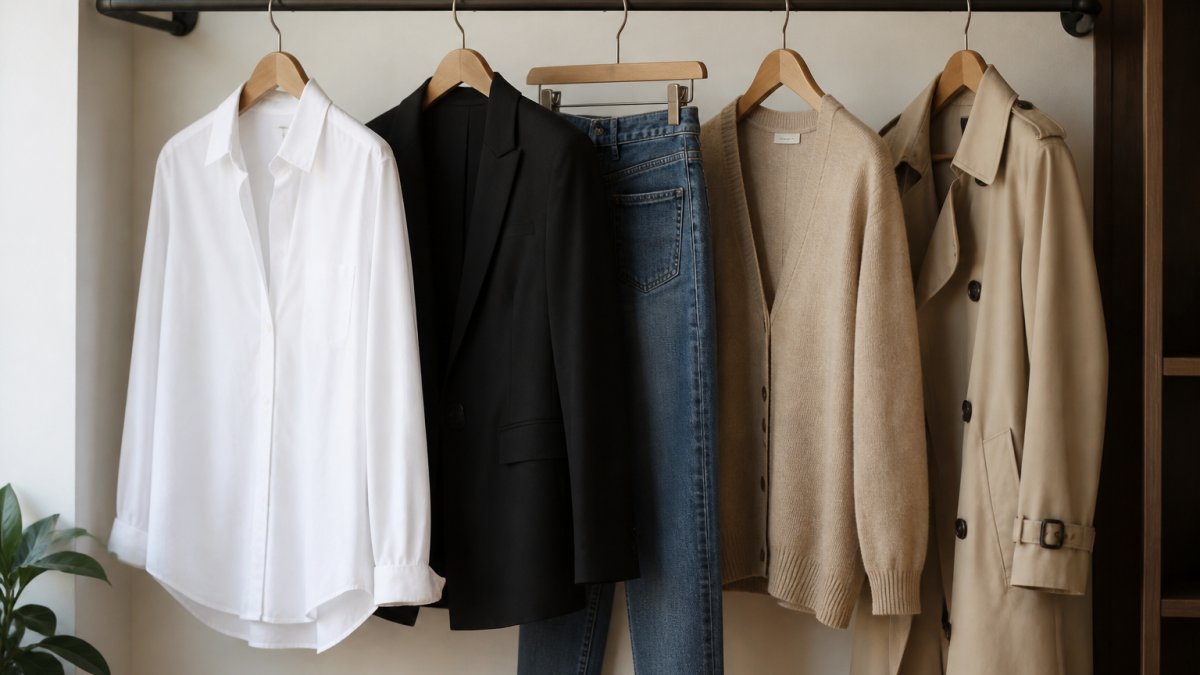
Versatile Pieces to Prioritize: Tops, Denim, and Layering Pieces
Versatile pieces are the ones that work in multiple settings. A crisp white button-up shirt moves from a client meeting to a weekend brunch. A well-cut pair of jeans anchors casual and smart outfits alike. A blazer or cardigan adds structure without effort.
At Shop, our curated collection is built around exactly these workhorses. The White Long Sleeve Button Up Shirt is a timeless piece suitable for all seasons, and the Boyfriend Blazer delivers real tailoring with the ease of a favorite sweater. The Studio Modern Boot Jeans round out the foundation with a simplified boot-cut leg that pairs with sneakers, boots, or heels.


How Many Pieces in a Capsule Wardrobe? Item Counts That Work
There is no universal number, but there is a workable range. A classic capsule typically lands between 30 and 40 pieces across tops, bottoms, layers, shoes, and outerwear. That count excludes accessories, workout gear, sleepwear, and special-occasion wear. The number matters less than the ratio: each piece should combine with at least three others.
A Flexible Capsule Wardrobe Checklist With Item Counts
Use the ranges below as a starting inventory, then adjust to your activity ratio and climate. The low end suits a mild climate and a narrow range of dress codes; the high end suits four seasons and mixed settings.
| Category | Count Range | What Counts | Notes |
|---|---|---|---|
| Tops | 8-12 | Tees, tanks, button-ups, blouses, knits | Include at least 2 that work for your most formal setting |
| Bottoms | 4-6 | Jeans, trousers, skirts, shorts | At least 1 dark denim and 1 tailored pair |
| Layers | 3-5 | Cardigans, blazers, hoodies, vests | One structured, one soft |
| Outerwear | 2-3 | Trench, wool coat, puffer | Match to your coldest and wettest months |
| Shoes | 3-5 | Sneakers, boots, flats, loafers, heels | One casual, one smart, one weatherproof |
| Accessories | 4-8 | Bag, belt, scarf, simple jewelry | Excluded from the 30-40 count |
A common starting point is 10 tops, 5 bottoms, 4 layers, 3 pairs of shoes, and 2 coats, which lands near 24 core pieces before accessories. Add pieces as your settings or seasons demand.
Adjust the Count for Season and Climate
A single capsule rarely covers a full year in a four-season climate. Two workable approaches:
- One capsule, rotated: Keep 30-40 pieces total and store off-season items. Swap lightweight tops for knits and add a puffer in winter; reverse in summer.
- Two capsules, split: Build a warm-weather capsule and a cold-weather capsule that share bottoms, shoes, and accessories. This keeps each season's closet focused and prevents overbuying.
Climate shifts the fabric and footwear list more than the count. In wet climates, prioritize water-resistant boots and a hooded or treated outer layer. In hot, humid climates, favor breathable fabrics like linen and cotton and add a light layer for air-conditioned interiors. In cold climates, count base layers and insulating mid-layers as part of the total, not as extras.
Define Each Piece Before You Buy
A checklist only works if each line item is specific. "A white shirt" is vague; "a white button-up that fits under a blazer and tucks into trousers" is a definition you can shop against. Write a one-line definition for every item on your list, including the setting it serves and the pieces it must combine with. That definition is what turns a generic list into a capsule you will actually wear.
Capsule Wardrobe Outfit Ideas: Mix and Match Formulas
Capsule wardrobe outfit ideas come down to repeatable formulas. Once your pieces share a palette, combinations multiply quickly. Three formulas cover most days:
- The everyday base: basic tee + classic denim + sneakers
- The polished layer: button-up + trousers + blazer
- The weekend ease: tank top + jeans + cardigan
Swap one element to shift the outfit's purpose. Add a trench coat and heels to formula one for dinner. Trade sneakers for boots and the same base reads sharper. This mix-and-match approach is why a modular wardrobe of fewer pieces still feels varied.
Budgeting, Cost per Wear, and Seasonal Wardrobe Adjustments
Cost per wear is the clearest way to judge whether a piece is worth its price. Divide the price by the number of times you expect to wear it.
This is the case for quality over quantity and intentional shopping. For guidance on textile durability and care standards, the FTC guidance on clothing care labels explains how to read care instructions that extend a garment's life.
Seasonal wardrobe adjustments keep a capsule functional year-round. In colder months, add layering pieces like the Dark Coffee Faux Suede Trench Coat and swap lightweight tops for knits. In warmer months, the Relaxed Button Down Shirt in a lightweight linen blend keeps things breathable.

A simple maintenance routine protects the investment:
- Wash according to care labels
- Repair loose buttons and seams promptly
- Store knits folded, not hung
This is where a capsule wardrobe pays off over time. Fewer, better pieces mean less clutter, faster mornings, and a wardrobe that always feels intentional.
Frequently Asked Questions
What is the 3-3-3 rule for a capsule wardrobe?
The 3-3-3 rule is a simple way to build a capsule wardrobe: choose three tops, three bottoms, and three pairs of shoes. Those nine pieces create 27 outfit combinations, which is enough for a workweek and a weekend. It works well as a starting point if a full capsule feels overwhelming. Once you see which combinations you actually wear, add layering pieces, a jacket, and one or two dresses to extend the capsule without adding clutter.
How many pieces should a classic capsule wardrobe have?
Most classic capsule wardrobes land between 30 and 40 pieces, including shoes and outerwear. A common breakdown is 10 tops, 6 bottoms, 3 to 4 layering pieces such as a cardigan or blazer, 3 outerwear pieces, 5 pairs of shoes, and 2 to 3 dresses. The exact number matters less than whether each piece earns its place. If you wear every item at least once every two weeks, the count is right for you.
What are the essential pieces in a classic capsule wardrobe checklist?
A solid checklist includes a white button-up shirt, basic tees, tank tops, classic denim, tailored trousers, a cardigan, a blazer, a quilted jacket or trench, sneakers, and one pair of dress shoes. Add a few casual tops and layering pieces you can mix and match. The goal is wardrobe essentials that work across everyday wear and dressier occasions, so you can create outfit combinations without buying anything new.
How do you choose a color palette for a capsule wardrobe?
Start with two or three neutral colors such as navy, cream, camel, gray, or dark brown, then add one or two accent colors you genuinely enjoy wearing. Every piece you buy should pair with at least three items you already own. This keeps the capsule modular, so mix and match options stay high. If you are unsure, hold each candidate item against your neutrals in daylight before buying.
Can a capsule wardrobe work for a busy mom who needs outfits for work and weekends?
Yes. Build the capsule around pieces that transition, like a relaxed button-down shirt, dark denim, and a blazer. A button-down works tucked with trousers for the office and open over a tank on weekends. The Studio Modern Boot Jeans, a mid-to-high rise bootcut with stretch, pair with sneakers or heels, so one pair of denim covers casual and polished days. Fewer, more versatile pieces mean faster decisions on busy mornings.
How do I keep a capsule wardrobe working across seasons and climates?
Use a core capsule of year-round pieces and swap in seasonal layers. Keep the same denim, trousers, tees, and button-ups, then rotate a lightweight linen blend shirt for summer and a faux suede trench or quilted jacket for cooler months. Store off-season items out of sight so your closet only shows what you can wear now. This seasonal wardrobe approach protects your closet organization and keeps outfit planning quick.
Building a capsule wardrobe that actually fits your life takes time, and getting the foundational pieces right matters most. At Shop, we hand-pick women's clothing, jewelry, and accessories designed for the modern, confident woman, whether you shop in-store or online. Our curated collections, styles for every season of life, and fast, careful shipping make it easy to build a wardrobe that works. Get started with Shop and dress with intention every day.
Leave a comment